
David Frankel, red button founders, and debonair uncles
Venture Lore issue #5

Welcome to issue #5 of Venture Lore, a newsletter devoted to covering what I learnt and / or found interesting, from podcast episodes and articles, pertaining to the venture capital industry.
In this issue, I cover a podcast episode, and an article. First the podcast: David Frankel of the storied Founder Collective appears on the 20VC podcast with Harry Stebbings. It is a good chat, especially useful for younger VCs (older VCs like me may not find a whole lot new!) or venture nerds. I was surprised by the fact they model 10x returns only while investing (see point 5 of my notes below), and was amused by his mention of Josh Kopelman’s ‘red button’ and ‘green button’ founders.
Next, an article by Mario Gabriele, titled 52 Tiny Venture Lessons, where he lists ‘tiny lessons’, each about a small paragraph long on the various learnings he has gathered in the course of his writings and learnings on venture. Some of it is obvious, some of it is fun, and a lot of it is useful.
Podcast
David Frankel, Founder Collective, on 20VC
14th October 2024
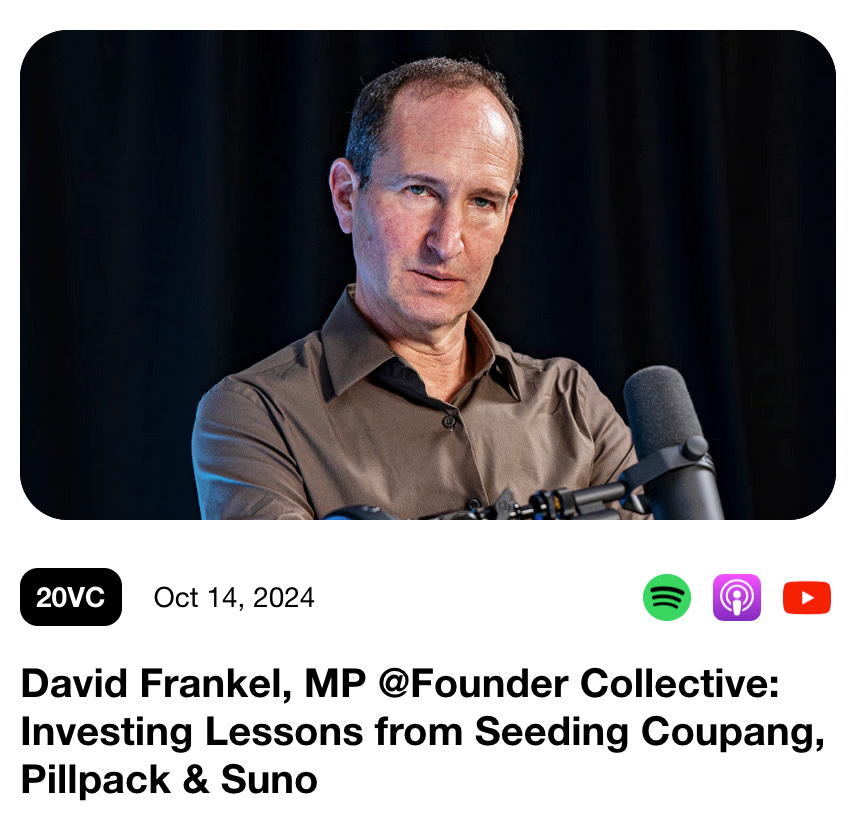
Link to podcast. Link to transcript, organised by 20VC. Apple Podcasts has free transcripts which are better than the 20VC organised one.
David Frankel is the cofounder and Managing Partner of Founder Collective, a storied seed fund, with investments in Uber, Trade Desk, Coupang, PillPack, Airtable etc.
Good episode, though more likely to appeal to venture nerds, and particularly useful to hear his perspectives on the challenges of deploying reserves and creating DPI (venture term for cash / liquidity / exits)
What I found interesting:
Reserves
Reserves strategy is one of the hardest aspects of the venture business, per David. Initially, at Founder Collective, they didn’t budget or plan for reserves but changed their mind after seeing Trade Desk (one of their big wins) come close to running out of money. Now they have moved to 1:1, that is 50% of the fund for first cheques and the remaining for follow ons (they are a sub $100m fund). Given that most companies in the seed stage don’t graduate, it means that a few of the (successful) companies get access to reserves.
Says Josh Kopelman of First Round Capital used to offer a $2m uncapped preemptive note for the upper quartile of their founders who are doing well.
1:1 is usually a common approach. The two extremes I have seen are Sauce VC, an Indian fund, where first cheques are about a third of the fund, and Benchmark Capital, where they hardly have any reserves (Sarah Tavel estimated here that as much as 90% of their capital goes into the primary cheque). My personal preference is for 60% to the first cheque and 40% to follow on. Typically even if you play the pro rata, you need less money to hold the pro rata. For instance presume you led a $3m round at the seed stage into a company to get 15%. In the subsequent Series A, let us assume it is $10m on $50m post. Then to maintain your pro rata you only need to play $1.5m. So pro rata reserves take up less money.
DPI challenges
Most funds post 2018, which includes their Fund III, are struggling on the DPI front. LPs are pissed, he says.
Harry Stebbings made an interesting point about David Swensen (Yale University endowment) era allocation logic not holding anymore given poor liquidity and lower hit rate, unlike when David Swensen decided to increase venture capital allocation.
The only exits are coming from PE firms rolling up SaaS companies he says (not M&A, not IPOs) and says he has been pleasantly surprised by PE firms’ value add and financial rigour.
When asked about how they think about distributing IPO proceeds he says, in case of the smaller ones like Desktop Metal they sell and distribute cash. For big ones like Uber etc they distribute stock (in specie distribution as it is called)
Watch out for your position on the Liq Pref stack: Says an LP told him, if you came in early and are under a lot of liq pref stacks then you are akin to common not pref stock.
When evaluating companies, they ask if it can go 10x. He says 4 x 10x companies can return their fund. It helps that it is a sub 100m fund.
Was surprised here. Usually VCs look for a fund-returner when they invest. Typically for a $100m fund with a 1:1 reserve strategy, the first cheque is $1.5m, and hence for about $3m invested (given the 1:1 reserves), you are expecting ~33x to get to a fund returner. The 10x took me by surprise, but the presumption here is a lower loss ratio. Hence you can afford a lower multiple expected. If you have a higher loss ratio, then you need an outsize returner.
LEECH
His acronym for Lethargic Economic Extractor Causing Harm, e.g., a company like Live Nation / Ticketmaster (competes with their portco SeatGeek) which is an incumbent monopolist
Red Button or Green Button Founders
Term coined by Josh Kopelman: essentially if a founder calls at 7pm family dinner time, would you take their call (even if to call them back).
Founder Collective’s biggest mistakes were when they picked the what over the who. They prefer Teams to Themes, he says
Recommends the book ‘The Path Between The Seas’, by David McCullough, on the building of the Panama Canal.
Article
Mario Gabriele lists 52 ‘tiny’ lessons gathered in the course of his research while writing The Generalists’ Investor Guide series on venture capital craft, which I had covered in my last newsletter.
My favourites were these two. The first one is a bit serious, and the second one is less so. Both are directionally correct:)
“Build the game you can win. You must build a game that you are singularly suited to play. That may be investing in the alumni of a startup you worked at or early-stage founders in a sector in which you have expertise. Find an unfair advantage and tilt the board to exploit it.”
“If you don’t understand how someone has a fund, it is probably because they have a very rich friend or family member. In your early days as a VC, you will meet a selection of relatively unimpressive fund managers with no unique advantages. They do not have a storied track record, outstanding operating experience, or a blue chip apprenticeship in their past. You will ask yourself, How? What am I missing here? What secret have they discovered that perhaps I, too, might learn and use to vault five steps forward? Do not waste your time: the ‘secret’ is usually a debonair uncle with the wealth of a small island nation.”
Bye
You can reach me at sp@sajithpai.com with your thoughts and questions!